Projects
Openfield
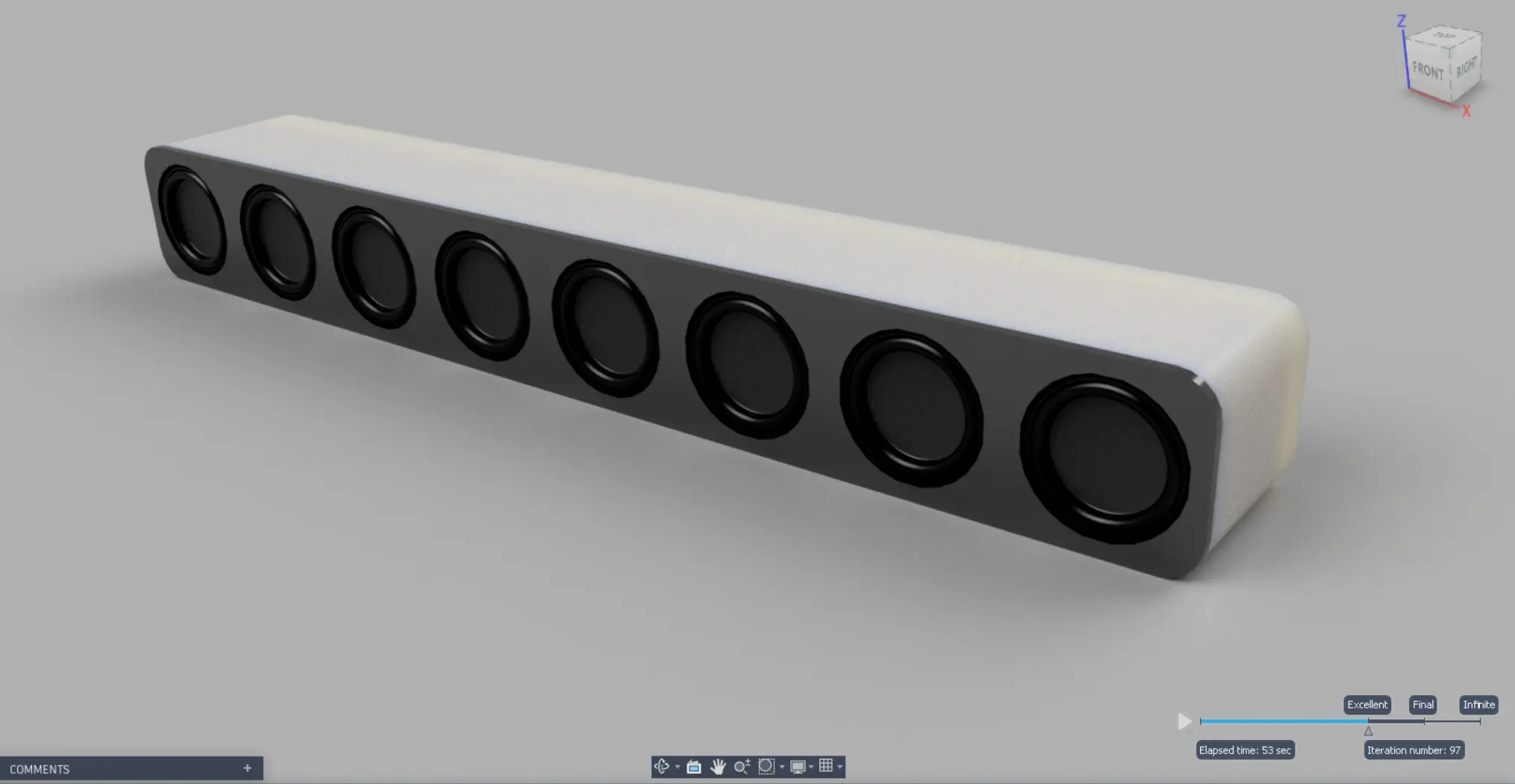
A modular, cost-effective loudspeaker array for artists and venues, evolved from The Line. Each 8-speaker bar (50×7×7 cm, under 1 kg) chains over a single connector up to 128 speakers driven by one Zynq FPGA. One USB line carries up to 16 audio sources positioned in space via MIDI, with wave field synthesis and beam steering built in, and embedded Linux for standalone installations. Hand-built in Lyon: CNC-routed enclosures, custom PCBs and control board.
wfs · beamforming · fpga · pcb · cnc · product
site
SolarNoon
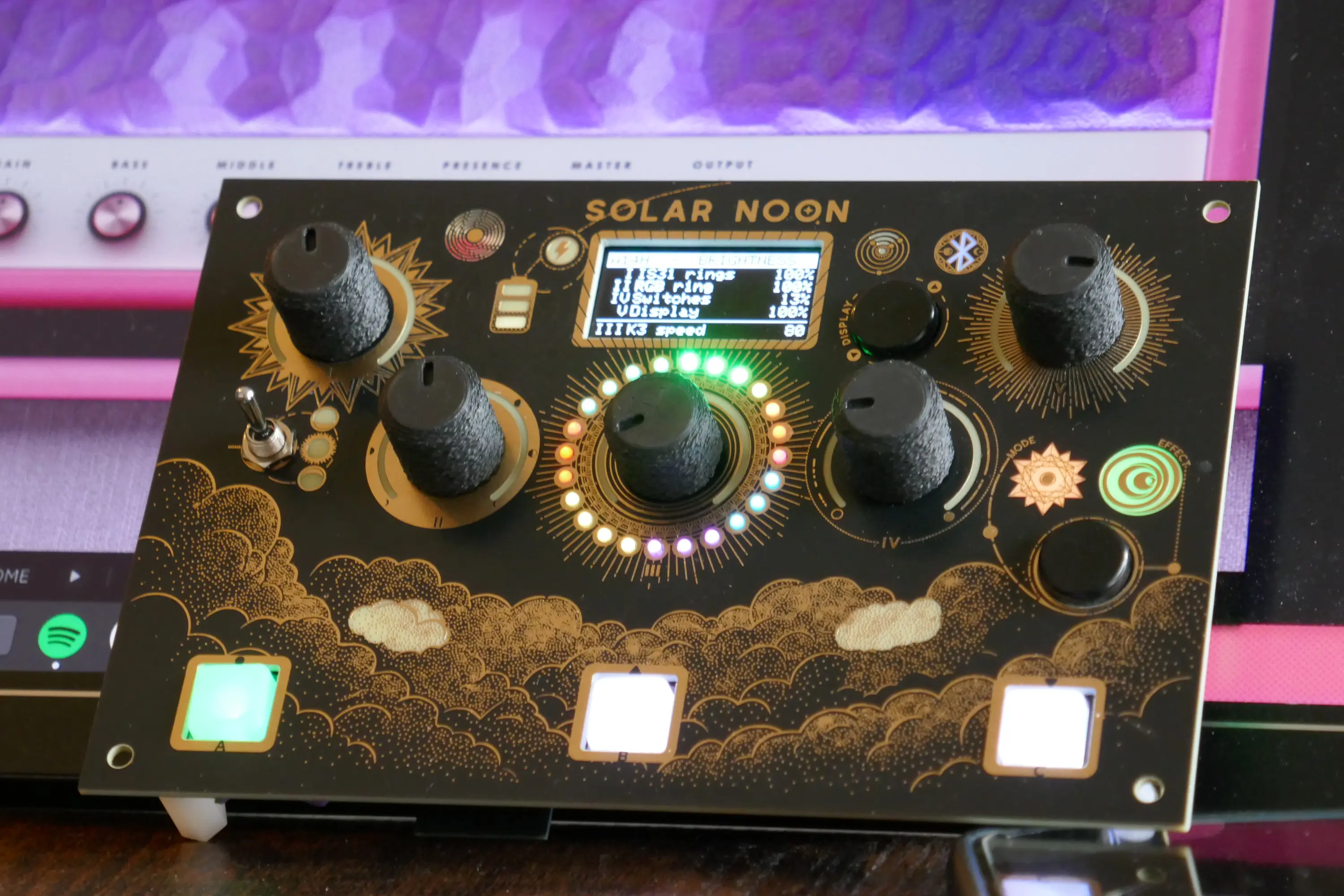
An ESP32-based MIDI controller built around the guitar pedal workflow: a few knobs, a screen that tells you what they do, and navigation between effects. Plugin mode maps your plugin from a config file with no code needed; Open mode is a fully programmable platform with a clean C++ API for custom displays and behaviors.
midi · hardware · pedal · firmware · bluetooth · pcb art
code
Umbilical
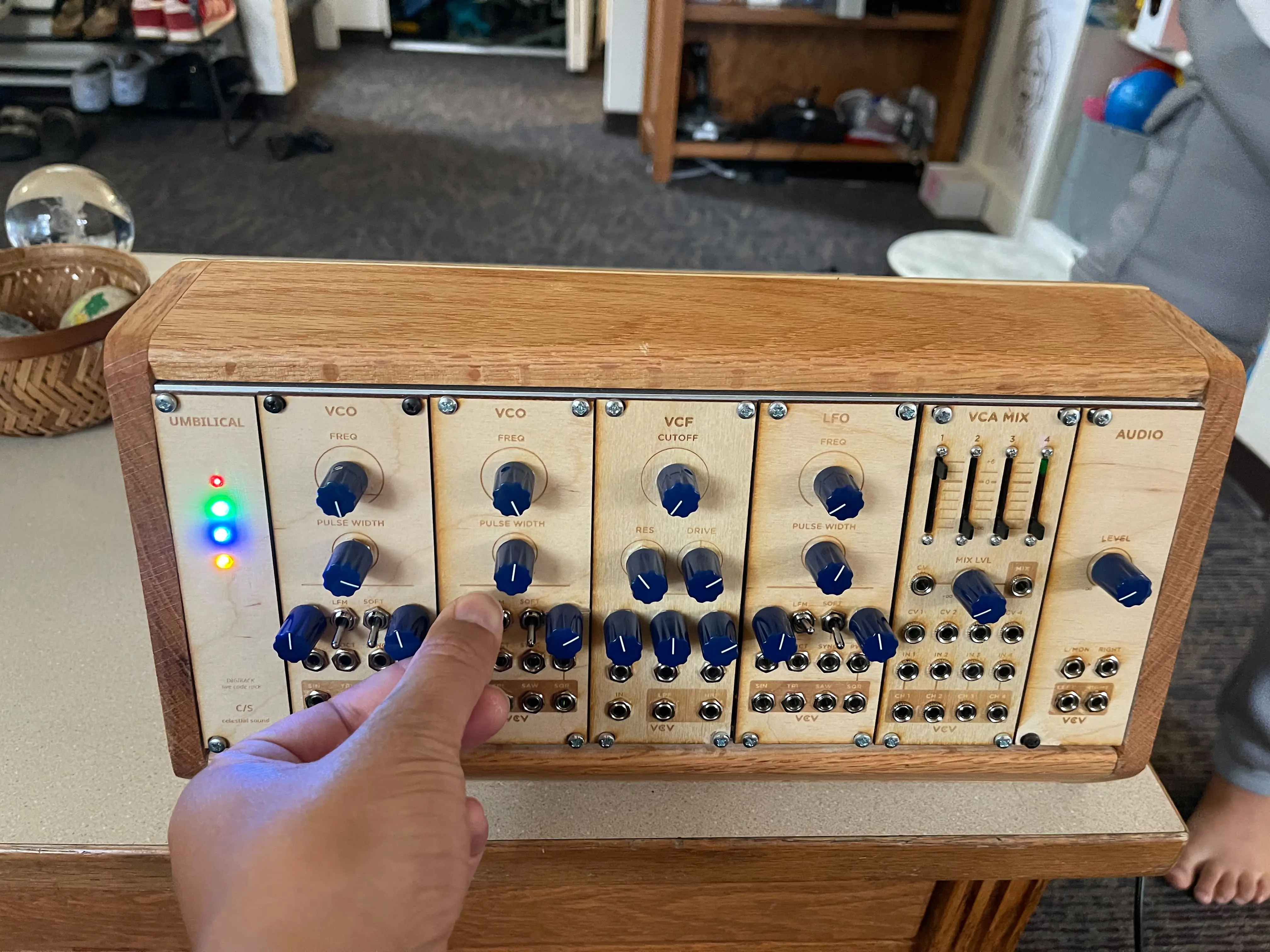
A project by Celeste Betancur. Umbilical is an OSC (Open Sound Control) patch controller and remote-control bridge module for VCV Rack, developed by Celestial Sound. It allows external applications and devices to query the patch graph, modify connections between module ports, and read/write module parameters dynamically over OSC.
osc · vcv rack · modular · c++ · remote control · pcb
code
Polyphonic
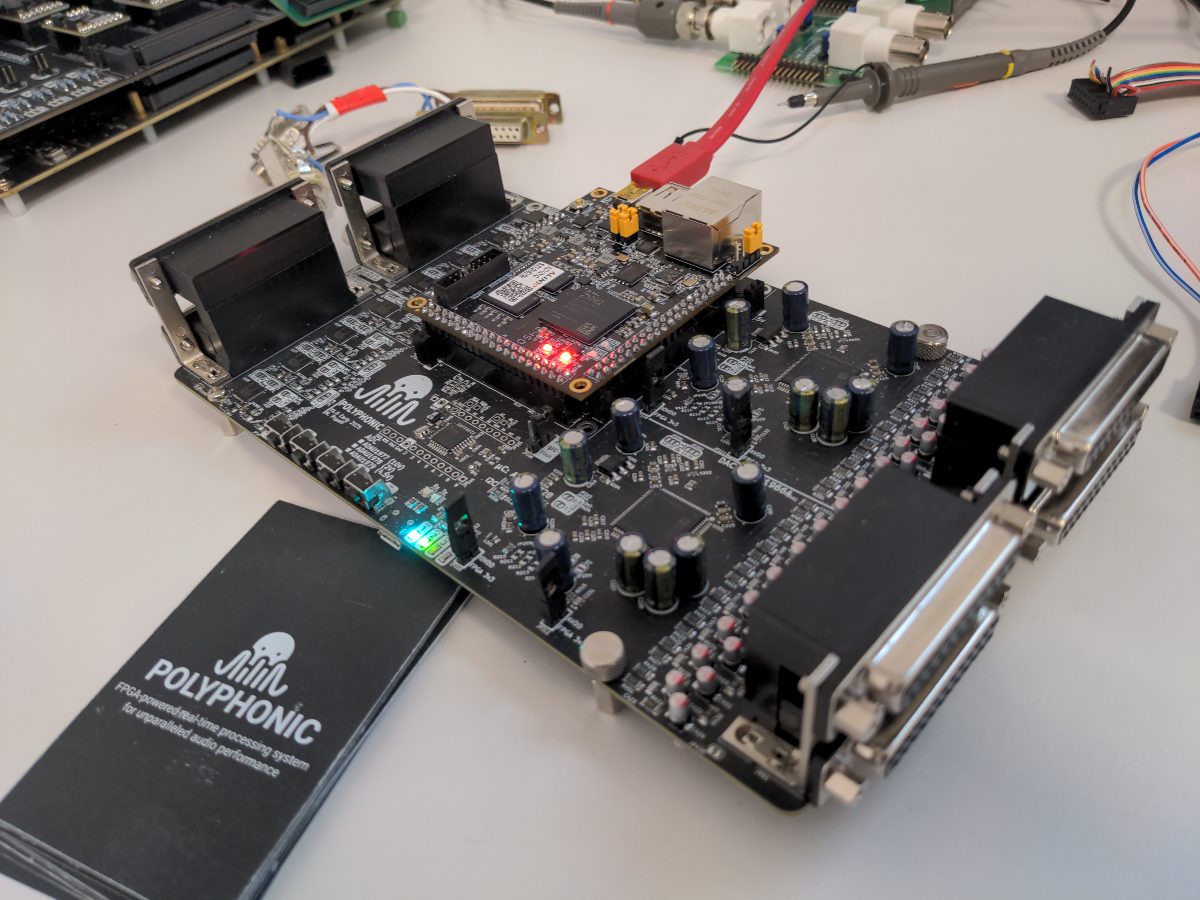
An Inria Startup Studio spin-off born from Syfala, productizing FPGA-powered real-time audio. Our proprietary compiler and custom boards turn high-level C++ or FAUST code into embedded hardware, hitting 11 µs analog-to-analog latency at up to 768 kHz, and scaling to hundreds of input/output channels for spatial audio and active noise control.
fpga · audio · low latency · multichannel · startup
site
Syfala Toolchain
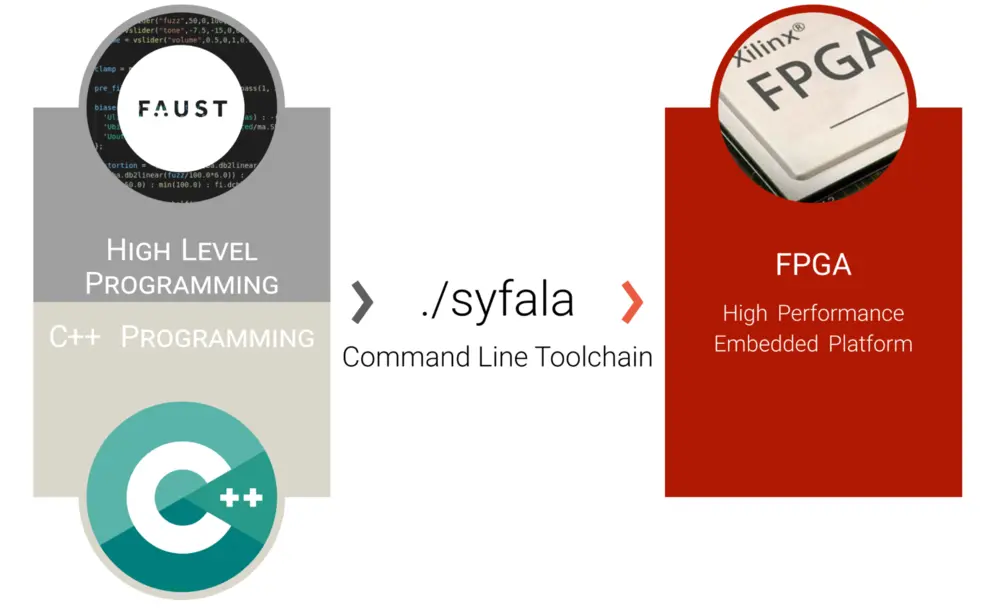
The FAUST to FPGA toolchain at the core of my PhD. Compiles high-level FAUST or C++ audio programs directly to FPGA hardware through high-level synthesis, reaching sample-level latency (a few µs) at very low power and scaling to massive multichannel systems with hundreds of audio I/O on a single FPGA.
faust · fpga · hls · c++
code docs
Syfala Boards
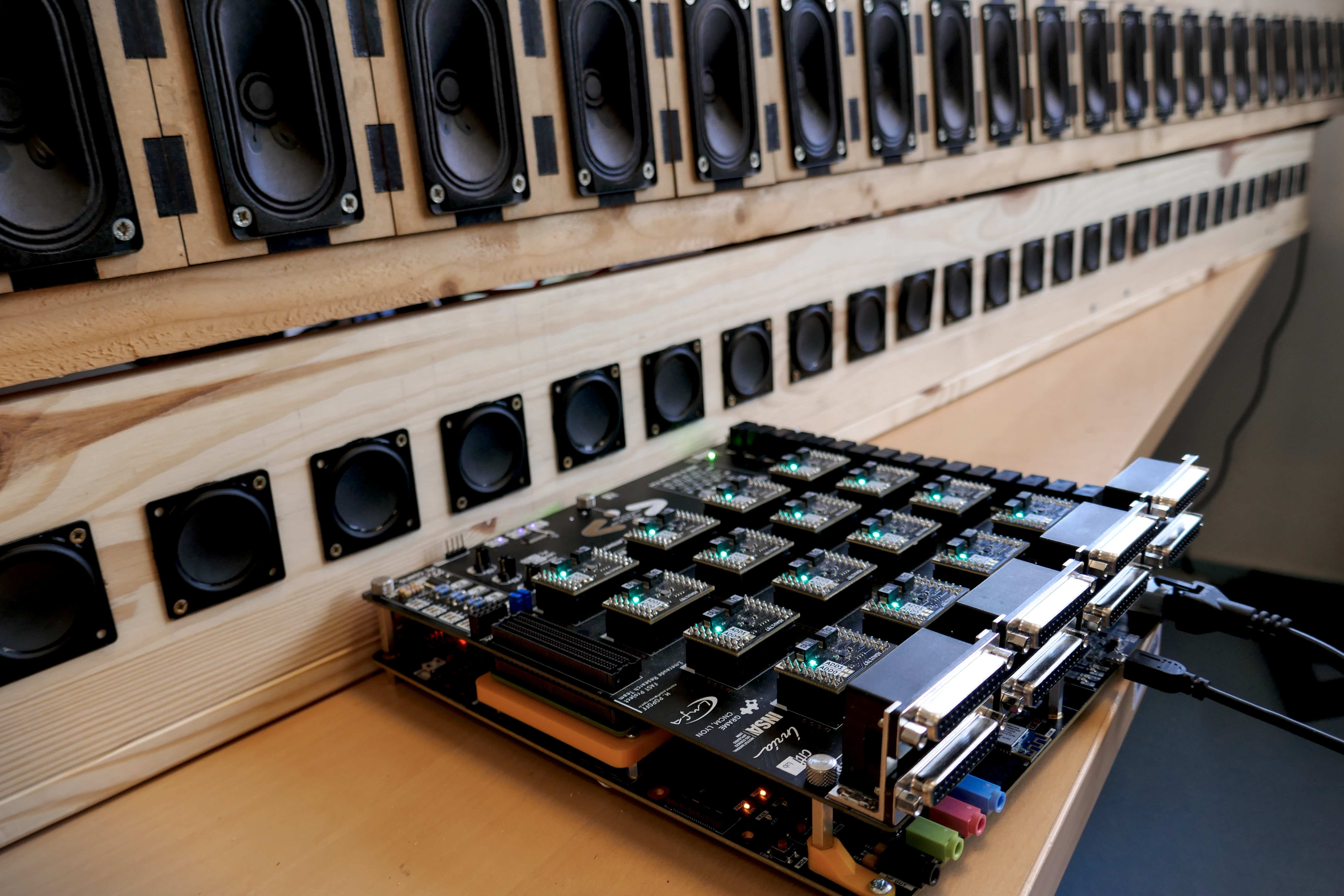
The custom hardware behind Syfala: FPGA carrier and audio expansion boards stacking multichannel ADC/DAC daughterboards to fan a single FPGA out to dozens of synchronized analog audio channels, the backbone of large-scale spatial-audio rigs like The Line.
fpga · pcb · multichannel · hardware · audio
code
The Line

A low-cost, massive multichannel Wave Field Synthesis loudspeaker bar built around Syfala: a single FPGA drives a dense line of independent speakers to physically reconstruct a sound field. Custom PCBs, integrated amplification, and sample-accurate timing across every channel.
wfs · spatial audio · fpga · multichannel · pcb
code
FourBrain
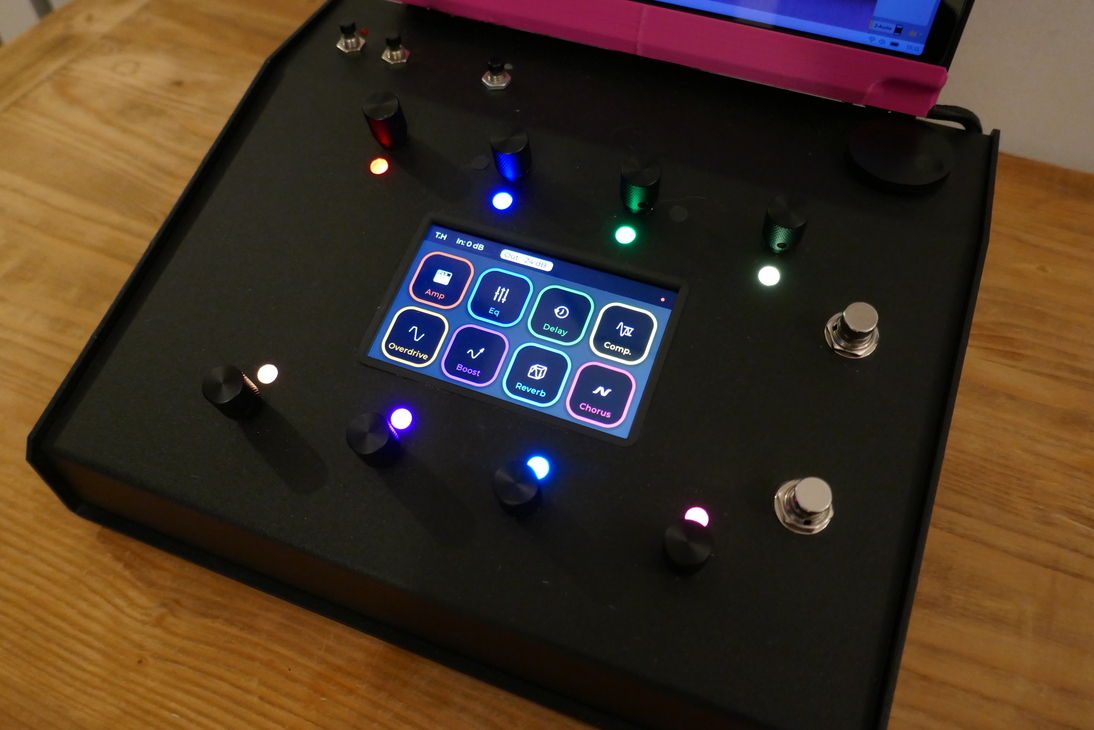
An open-source Arduino-based MIDI control surface for Neural DSP Archetype plugins, with full bi-directional feedback: turn a knob and the plugin follows; change the plugin and the controller follows. Built for a compact, headphone-friendly guitar rig: Arduino GIGA, 8 RGB rotary encoders, footswitches, and a custom Ableton remote script.
arduino · midi · c++ · hardware · audio
code
Publications
Embedded, Modular, and Affordable High-Density Loudspeaker Arrays
M. Popoff, R. Michon, P. Cochard, T. Risset · NIME 2026 · doi:10.5281/zenodo.20784324
Scalable loudspeaker arrays for spatial audio research typically require complex multichannel hardware, limiting the practical deployment of high-density configurations. We introduce a modular loudspeaker array design that supports a wide range of geometries without hardware modification. The system integrates an embedded FPGA system-on-module with compact 8-channel loudspeaker printed circuit boards (PCBs) that can be easily daisy-chained. Each module uses PCB-mounted drivers to maximize spatial density and ensure consistent acoustic and mechanical characteristics across the array. Controlling such a system with hundreds of loudspeakers requires handling timing-critical operations and distributed, synchronized audio streams with minimal I/O overhead. This is achieved using an embedded Xilinx Zynq-7000 FPGA: the current prototype has been tested with 64 speakers, and the architecture supports configurations of up to 768 channels. The modular PCB design enables rapid reconfiguration into linear, circular, or two-dimensional layouts without modifying the underlying signal-distribution or processing architecture. This platform provides an accessible, open-source foundation for evaluating spatial audio applications under high-channel-count conditions.
pdf
Frugalité et conception de circuits pour le traitement du signal audio numérique
M. Popoff, R. Michon, T. Risset, P. Cochard, L. Ledoux, S. Letz, Y. Orlarey, F. de Dinechin · RFIM 2025
Les FPGAs (Field-Programmable Gate Arrays, ou circuits programmables) sont des plateformes embarquées offrant des performances inégalées en termes de latence audio, de capacité de calcul, de gestion d’un grand nombre de canaux audio (entrées/sorties) et de consommation énergétique. La programmation des FPGAs est réputée complexe, notamment en raison de l’utilisation de langages de description de matériel. La synthèse de haut niveau permet toutefois de s’affranchir d’une partie de cette complexité, rendant la programmation des FPGAs plus accessible. Cet article présente l’outil SyFaLa, qui permet la compilation de programmes de traitement du signal audio à partir du langage de programmation Faust. Il introduit tout d’abord le fonctionnement des plateformes FPGA ainsi que les outils de programmation associés. Il illustre ensuite plusieurs réalisations dites « frugales » utilisant des FPGAs et développées grâce à SyFaLa, comme par exemple un système de diffusion WFS à bas coût. La compilation de programmes audio sur FPGA permet d’envisager, dans un avenir proche, la compilation vers des circuits dédiés tels que des ASICs (circuits dédiés), dont le mode de conception est proche de celui de la programmation FPGA. L’article se conclut par un recensement d’outils et de logiciels libres permettant, à un coût très raisonnable, la mise en place de circuits audio numériques à partir de spécifications de haut niveau.
pdf
Compilation of real-time audio DSP on FPGA
M. Popoff · PhD Thesis 2024
Field-Programmable Gate Arrays (FPGAs) are powerful embedded platforms that offer unique performance in terms of throughput, computational power, and a large number of inputs/outputs, making them highly suited to real-time audio processing. However, programming them presents significant challenges. High-Level Synthesis (HLS) bypasses complex hardware description languages (HDLs) traditionally used for FPGA programming, streamlining the compilation process and enabling high-level audio DSP specifications to be directly converted into FPGA bitstreams. Still, this approach remains difficult to generalize for various audio programs. This thesis presents the principles of real-time audio DSP implementation on FPGAs using HLS tools. It introduces a general methodology for generating optimized C++ code for audio DSP with HLS and presents the first “audio DSP compiler” specifically targeting FPGAs. This compilation flow leverages the use of FAUST, a high-level functional programming language designed for sound synthesis and audio processing, to program FPGAs. Two major technological breakthroughs are presented: achieving ultra-low latency for real-time audio DSP (on the microsecond scale) and the ability to easily deploy massive multichannel systems, opening new research perspectives, particularly in the fields of audio spatialization and active acoustic control applications.
pdf
Enabling Affordable and Scalable Audio Spatialization With Multichannel Audio Expansion Boards for FPGA
M. Popoff, R. Michon, T. Risset · SMC 2024 · doi:10.5281/zenodo.14361659
The implementation of audio spatialization and active acoustic control techniques requires a large number of audio channels and significant computational resources, making these techniques costly and hardly accessible. The use of Field-Programmable Gate Arrays (FPGAs) offers a solution by enabling DSP programming within a centralized system with enough computational power and inputs/outputs to handle all audio streams. However, physically interfacing an embedded system with multiple audio channels is a complex process that poses a significant challenge to system accessibility. In this paper, we present two open-source circuit boards facilitating the interfacing between an FPGA and large multichannel systems, both aiming different kinds of approaches. The first board is designed to be cost-effective and easily reproducible. The second involves more complex manufacturing techniques, but it allows us to fully exploit the performances of the FPGA. Each board provides 32 audio channels and has stacking capabilities, allowing for the interfacing of up to 512 channels on a single FPGA. Their integration into the Syfala compilation flow facilitates the implementation of algorithms without hardware concerns. These interfaces aim to enhance accessibility and affordability when implementing audio spatialization and active acoustic control systems.
pdf
Programming FPGA Platforms for Real-Time Audio Signal Processing In C++
P. Cochard, M. Popoff, R. Michon, T. Risset · SMC 2024 · doi:10.5281/zenodo.14361590
Syfala is a toolchain aiming to facilitate the development of real-time audio Digital Signal Processing (DSP) applications on Field-Programmable Gate Array (FPGA) platforms. Since its introduction in 2021, the project has been relying on the FAUST programming language as its primary programming interface. The resulting C++ code generated by the FAUST compiler can be easily translated into Hardware Description Language (HDL) code using High Level Synthesis (HLS), thereby facilitating integration into FPGA designs. However, FPGA platforms may in some cases require very specific tuning and optimizations in order to reach their full potential, which FAUST can sometimes fail to provide, because of its platform-agnostic nature. In this technical paper, we present a new way of using Syfala with C++ and HLS. This potentially allows for a better control over parallelization and pipelining as well as for potentially more optimized and efficient code for AMD/Xilinx FPGA platforms. This method can greatly facilitate the implementation of complex DSP algorithms on FPGAs for C++ programmers. Finally, we highlight the performance gains obtained by using this methodology with respect to the original Syfala toolchain starting from FAUST programs.
pdf
Audio DSP to FPGA Compilation
M. Popoff, R. Michon, T. Risset, P. Cochard, S. Letz, Y. Orlarey, F. de Dinechin · IEEE ASAP 2023 · doi:10.1109/ASAP57973.2023.00018
The implementation of real-time audio Digital Signal Processing (DSP) applications on FPGA has been extensively studied in the past. Up to now, Audio IPs were designed either “by hand” in VHDL or using predefined IPs in block synthesis environments. The advent of High Level Synthesis (HLS) allows for a real compilation flow from high-level audio DSP specifications down to FPGA bit-streams. This paper presents the principles and the implementation of the first “audio DSP compiler” targeting FPGAs. Our fully open-source system compiles audio DSP programs down to FPGA hardware and up to actual sound production. This compilation flow presents two important technological breakthroughs for audio programmers: achieving ultra-low latency real-time audio DSP (few micro-seconds) and the possibility of easily deploying systems with a large number of audio channels.
pdf code
Audio DSP to FPGA Compilation: The Syfala Toolchain Approach
M. Popoff, R. Michon, T. Risset, P. Cochard, S. Letz, Y. Orlarey, F. de Dinechin · Report 2023
The implementation of real-time audio Digital Signal Processing (DSP) on FPGA has been extensively studied in the past. Up to now, Audio IPs were designed either “by hand” in VHDL or using predefined IPs in block synthesis environments. The advent of High Level Synthesis (HLS) allows for a real compilation flow from high-level audio DSP specifications down to FPGA bit-streams. This paper presents the principles and the implementation of the first “audio DSP compiler” targeting FPGAs. Our fully open-source system compiles audio DSP programs down to FPGA hardware and up to actual sound production. Many parameters such as the number of output channels, sampling rate, etc. are adjusted automatically by the compiler. Software interfaces can be generated to control the system in real-time. This compilation flow presents two important technological breakthroughs for audio programmers: achieving ultra-low latency real-time audio DSP (few micro-seconds) and the possibility of easily deploying systems with a large number of audio channels.
pdf code
Making Frugal Spatial Audio Systems Using Field-Programmable Gate Arrays
R. Michon, J. Bizien, M. Popoff, T. Risset · NIME 2023 · doi:10.5281/zenodo.11189100
Spatial audio systems are expensive, mostly because they usually imply the use of a wide range of speakers and hence audio outputs. Some techniques such as Wave Field Synthesis (WFS) are especially demanding in that regard making them out of reach to many individuals or even institutions. In this paper, we propose to leverage recent progress made using Field-Programmable Gate Arrays (FPGA) in the context of real-time audio signal processing to implement frugal spatial audio systems. We focus on the case of WFS and we demonstrate how to build a 32 speakers system that can manage multiple sources in parallel for less than 800 USD (including speakers). We believe that this approach contributes to making advanced spatial audio techniques more accessible.
pdf
A Programmable Linux-Based FPGA Platform for Audio DSP
P. Cochard, M. Popoff, A. Fraboulet, T. Risset, S. Letz, R. Michon · SMC 2023
Recent projects have been proposing the use of FPGAs (Field Programmable Gate Array) as hardware accelerators for high computing power real-time audio Digital Signal Processing (DSP). Most of them imply specific developments which cannot be re-used between different applications. In this paper, we present an accessible FPGA-based platform optimized for audio applications programmable with the FAUST language and offering advanced control capabilities. Our system allows fast and simple deployment of DSP hardware accelerators for any Linux audio application on Xilinx FPGA platforms. It combines the Syfala compiler – which can be used to generate FPGA bitstreams directly from a FAUST program – with a ready-made embedded Linux distribution running on the Xilinx Zynq SoC. It enables the compilation of complete audio applications involving various control protocols and approaches such as OSC (Open Sound Control) through Ethernet or Wi-Fi, MIDI, web interfaces running on an HTTPD server, etc. This work opens the door to the integration of hardware accelerators in high-level computer music programming environments such as Pure Data, SuperCollider, etc.
pdf
Towards an FPGA-Based Compilation Flow for Ultra-Low Latency Audio Signal Processing
M. Popoff, R. Michon, T. Risset, Y. Orlarey, S. Letz · SMC 2022 · doi:10.5281/zenodo.6573619
Field Programmable Gate Arrays (FPGAs) have been increasingly used in recent years for real-time audio Digital Signal Processing (DSP) applications. They provide unparalleled audio latency and processing power performances. They can target extremely high audio sampling rates and their large number of General Purpose Inputs and Outputs (GPIOs) make them particularly adapted to the development of large scale systems with an extended number of analog audio inputs and outputs. On the other hand, programming them is extremely complex and out of reach to non-specialized engineers as well as to most people in the audio community. In this paper, we introduce a comprehensive FPGA-based environment for real-time audio DSP programmable at a high level with the FAUST programming language. Our system reaches unequaled latency performances (11 µs round-trip) and can be easily controlled using both a software graphical user interface and a dedicated hardware controller taking the form of a sister board for our FPGA board. The implementation of the system is described in details and its performances are evaluated. Directions for future work and potential applications are presented as well.
pdf
Feedback Acoustic Noise Control with Faust on FPGA: Application to Noise Reduction in Headphones
L. Alexandre, P. Lecomte, M-A. Galland, M. Popoff · IFC 2022 · doi:10.5281/zenodo.6799613
This work studies the feedback Active Noise Control (ANC) in a headphone with a digital filter implemented on a FPGA instead of an analog filter, in the context of a pedagogical practice bench. The digital approach allows greater flexibility in setting the feedback ANC filter but brings an additional latency that can compromise the ANC efficiency. The principle of feedback ANC in headphones is reviewed and the choice of a biquadratic filter as a feedback ANC filter is argued. The digital filter is programmed in the FAUST language and compiled on a FPGA platform. An experimental validation is carried out to compare the attenuation performance between the digital and analog biquadratic filters. The results show similar or even better low frequency attenuation for some configurations of the digital biquadratic filter compared to the analog filter. Finally, a digital filter cascading two biquads is studied and shows a bandwidth broadening where the ANC is effective.
pdf